
2026 Midterms Betting Sees $1.4B Surge That Disrupts US Politics
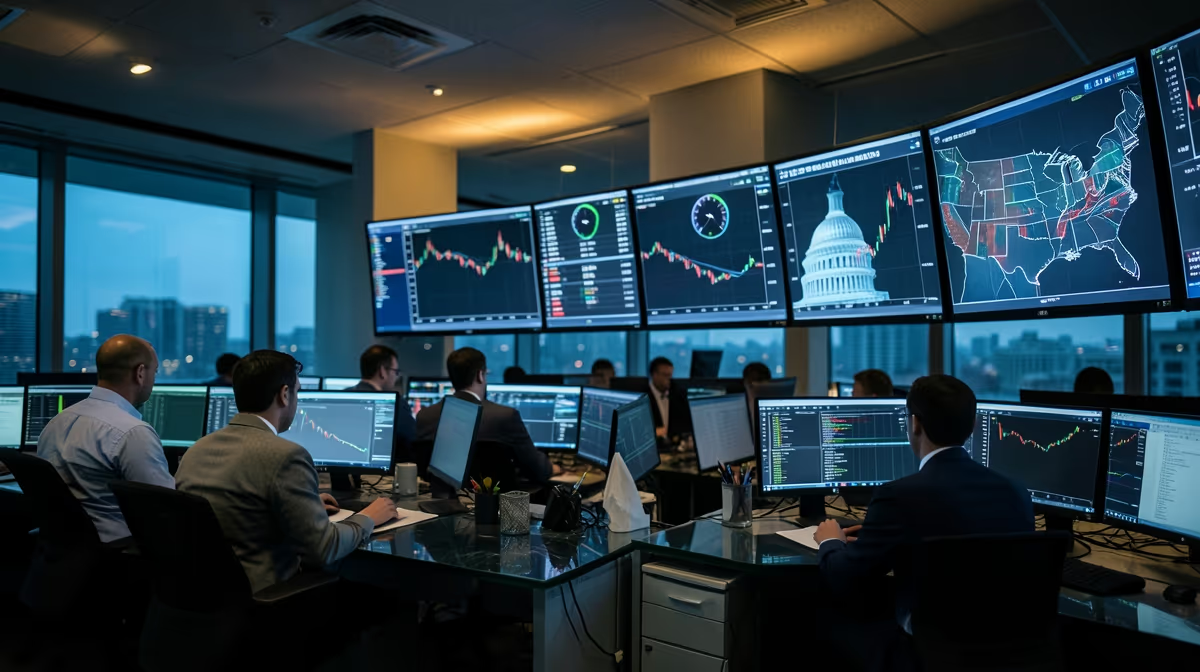
Financial markets have long priced corporate earnings and commodities, but the democratic ballot box is rapidly turning into one of the financial world's most dynamic liquid spaces. The landscape of 2026 midterms betting has crossed an unprecedented threshold, with trading volumes surging past $1.4 billion across major platforms as institutional and retail capital floods political event contracts.
Over $1.4 billion in capital has poured into 2026 midterm contracts, signaling a profound migration from traditional polling to live financial speculation.
This massive volume, reported by CNN, represents a fundamental shift in how public events, elections, and civic outcomes are monitored and evaluated. Rather than waiting for delayed sample surveys or subjective punditry, market participants are executing trades on regulated exchanges, converting probabilistic outcomes into tradable derivatives. The intersection of real-money wagering, aggressive mainstream marketing, and algorithmic trading is establishing a permanent infrastructure for event-based finance.
The Scale of Midterm Prediction Market Volume
The financial scale directed at the 2026 midterm elections marks a watershed moment for event derivative exchanges. According to reporting confirmed by CNN, cumulative trading activity on prediction markets has surpassed $1.4 billion specifically tied to the upcoming congressional contests.
More than $1.4 billion has been traded on prediction markets specifically for the 2026 midterms.
The velocity of this capital demonstrates that political forecasting is no longer an auxiliary feature of online trading. Instead, it has transformed into a primary driver of volume. Where traditional polling offers an intermittent snapshot of voter sentiment hampered by non-response rates and demographic modeling assumptions, prediction markets function continuously. Every contract represents real capital at risk, forcing traders to price probabilities in real time as news breaks, policy debates unfold, and candidate viability fluctuates.
For finance professionals, political analysts, and tech-forward investors, this $1.4 billion threshold signals liquidity depth. Higher volume reduces bid-ask spreads, making it viable for larger market participants to hedge political risk or capitalize on perceived mispricings. As trading activity accelerates well in advance of the election cycle, the volume itself becomes a major reference point for media outlets and campaign observers.
From Academic Experiments to Regulated Financial Derivatives
The current surge in prediction market activity is rooted in an institutional evolution spanning several decades. For years, prediction markets operated primarily as niche experiments or academic exercises designed to test the aggregation of collective wisdom. These early platforms demonstrated that decentralized pools of individuals wagering limited sums could frequently outperform professional forecasters on everything from economic indicators to general elections.
However, those early systems lacked regulatory integration, institutional liquidity, and mainstream accessibility. The emergence of federally regulated exchanges has bridged the divide between speculative novelty and formal financial architecture. Platforms like Kalshi operate as fully regulated exchanges offering event contracts, legitimizing political and event-based wagering within established derivative frameworks.
This transformation mirrors modern commodity futures markets, which originally developed from localized agricultural hedging agreements into multi-billion-dollar derivative ecosystems. Just as futures contracts separated price risk from the physical delivery of grain or crude oil, modern event contracts separate macroeconomic and political probability from traditional investment vehicles, creating an independent financial asset class.
Aggressive Mainstream Expansion and Cultural Promotion
The influx of capital into Kalshi prediction markets has not occurred in a vacuum. It is being accelerated by aggressive consumer marketing, high-budget media campaigns, and retail onboarding strategies.
To expand platform visibility beyond niche trading desks, operators have enlisted prominent entertainment figures to anchor major promotional pushes. Kalshi recently launched an absurdist four-minute commercial starring comedians Shane Gillis and Danny McBride playing rival weathermen. The high-profile campaign emphasizes forecasting, probability, and market competition through mainstream comedy, directly targeting retail audiences who may not have previously traded financial derivatives.
Simultaneously, platforms are utilizing targeted financial incentives to lower the barrier to entry. User acquisition campaigns—such as promotional codes offering a $55 bonus for a $25 trade tied to major sporting events like World Series Game 2 and college football matchups like Ole Miss versus Texas—serve as gateways to broader platform engagement. Once registered to trade on sports or cultural outcomes, participants are seamlessly introduced to political books and electoral markets.
Beyond politics and athletics, platforms are pushing into unconventional, highly localized categories. Kalshi has moved to launch prediction contracts covering college admission rates across 22 institutions, including Duke University and other elite schools. This constant diversification embeds event trading into everyday discourse, normalizing financial speculation across diverse segments of public life.
The Mechanics of Financialized Politics
The convergence of multi-billion-dollar trading volumes and democratic processes highlights the swift rise of financialized politics. When election outcomes are traded as liquid assets, the incentives governing public perception undergo a structural change.
Market Sentiment Versus Traditional Polling
The Hidden Feedback Loop
Geopolitical and Institutional Implications
As United States domestic elections turn into massive financial venues with billions of dollars at stake, their significance resonates beyond domestic borders. American political stability, legislative composition, and regulatory leadership are inherently tied to global economic conditions.
With prediction platforms achieving deep liquidity, international investors and foreign observers gain unprecedented access to continuous, probability-based assessments of American political trajectories. The ability to watch real-time financial sentiment surrounding congressional control provides global market participants with an additional tool to hedge macroeconomic exposures tied to trade, tax, and foreign policy.
At the same time, the transition of civic processes into speculative derivative markets raises fundamental institutional questions. When democratic elections generate over a billion dollars in trading volume years ahead of balloting, public perception risks shifting from civic participation to commercial speculation. Observers continue to scrutinize whether treating governance as a tradable contract strengthens market efficiency or gamifies constitutional procedures.
Regulatory Scrutiny and Future Trajectories
The rapid expansion of event contracts into sensitive public arenas is intensifying debates among regulators, educational institutions, and legislative observers. The ongoing trajectory of prediction markets presents distinct potential paths.
Over the immediate short term, prediction market platforms are projected to leverage high-profile promotional campaigns and expand into unconventional betting categories, driving further user engagement ahead of upcoming major events. Within subsequent days and weeks, increased public and media discourse surrounding the legality, ethics, and mainstream normalization of these markets—especially concerning congressional races and institutional metrics like college admission rates—is likely to draw heightened scrutiny.
Industry analysts expect that the rapid scaling of prediction markets into political and non-traditional consumer sectors will accelerate mainstream adoption while simultaneously intensifying regulatory oversight.
- Under a best-case trajectory, prediction markets provide unprecedented accuracy in forecasting political outcomes and consumer trends, operating seamlessly under transparent regulatory frameworks while offering innovative risk-management products.
- Under a worst-case trajectory, over-expansion into sensitive arenas—such as college admissions decisions and high-stakes political contests—could trigger severe regulatory pushback, consumer protection concerns, and ethical controversies regarding the financial exploitation of civic institutions.
Whether regulatory oversight of these platforms will expand in response to rising volumes on political events remains a developing question. As the 2026 election cycle approaches, the interaction between regulatory authorities and derivative exchanges will define the boundaries of event-based finance.
Frequently Asked Questions
How much money has been traded on prediction markets for the 2026 midterms?
More than $1.4 billion has been traded on prediction markets specifically for the 2026 midterm elections. This massive volume highlights the surging popularity and financial engagement surrounding political forecasting platforms.
Why are prediction markets gaining so much attention for the 2026 elections?
These markets provide a real-time, financially backed gauge of public sentiment and election probabilities that often rivals traditional polling. Platforms like Kalshi are expanding their mainstream visibility through high-profile promotional campaigns and diverse wagering options.
Who is affected by the rise of political prediction markets?
Voters, political analysts, and campaign strategists are increasingly influenced by the trends shown on these platforms. Additionally, everyday retail traders participate in these markets, treating political outcomes similarly to financial assets.
What happens next as the 2026 midterms approach?
As election day draws closer, trading volumes on platforms like Kalshi are expected to accelerate significantly. Observers will continue monitoring these markets to gauge shifting political momentum in real time.
What is the background of prediction market platforms like Kalshi?
Kalshi operates as a regulated financial exchange that allows users to trade event contracts on real-world occurrences, ranging from elections to college admissions rates. The platform has been aggressively expanding its market offerings and visibility through major advertising efforts.
What specific events or promotions are currently associated with Kalshi?
Aside from political prediction markets, Kalshi has engaged in prominent advertising campaigns, such as partnering with public figures like Shane Gillis and Danny McBride for absurdist promotional spots. The platform also routinely offers user bonuses tied to major sporting events like World Series games.
Conclusion
The accumulation of more than $1.4 billion in trading volume on the 2026 midterm elections confirms that prediction markets have successfully transitioned from academic experiments into major financial venues. By turning political forecasting into liquid derivative contracts, platforms like Kalshi have introduced a continuous, real-time alternative to traditional polling methods. However, this mainstream growth—fueled by aggressive advertising campaigns, high-profile comedy spots, and novel contracts ranging from sporting events to college admissions—has placed prediction exchanges directly under public and regulatory scrutiny. As trading volumes expand toward the midterms, the market's ongoing challenge will center on balancing liquidity, platform innovation, and compliance within established regulatory frameworks.
Sources
- Shane Gillis and Danny McBride Are Rival Weathermen in Absurdist, 4-Minute Kalshi Ad (EXCLUSIVE) — Variety
- Kalshi Promo Code AL55: Score a $55 bonus with a $25 trade on World Series Game 2 — AL.com
- Kalshi Promo Code AL55: Claim a $55 bonus for Ole Miss vs. Texas & World Series Game 2 — AL.com
- More than $1.4 billion has been traded on prediction markets for the 2026 midterms — CNN
- Kalshi Could Let You Wager on Admission Rates at 22 Colleges — Inside Higher Ed
- Kalshi to launch prediction market for admission rates at Duke, other top schools — The Duke Chronicle


